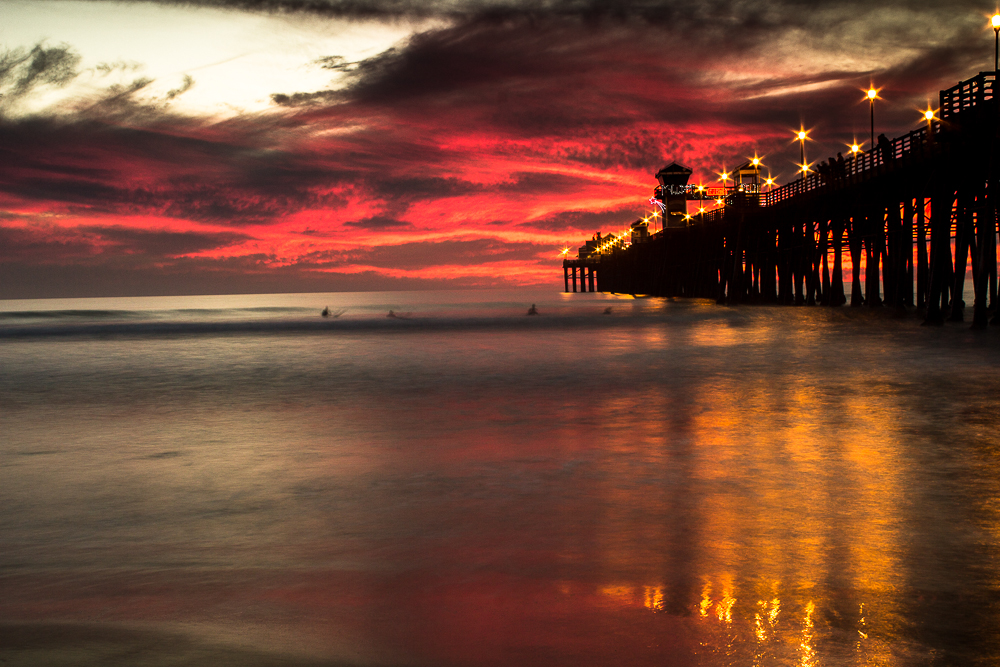
St. Johns River by Heather Hummel

St. Johns River by Heather Hummel
St. Johns River by Heather Hummel Photography
Showing posts with label low light photography. Show all posts

Thursday, May 24, 2018

7 Steps to Stunning Images: A FREE Online Course by Heather Hummel Photography

7 Steps to Stunning Images: A Guide to Mastering Your DSLR Camera by Heather Hummel, land and seascape photographer, is a FREE online course that demystifies your DSLR camera and delves into the following 7 critical photography concepts as well as one "In the Field with Heather Hummel Photography" video. 
Course content includes:
  • Step 1: Shedding Light on Light Sources
  • Step 2: Conquer ISO Settings
  • Step 3: Understanding Aperture/Depth of Field
  • Step 4: Choosing a Shutter Speed
  • Step 5: Composition
  • Step 6: Tripods
  • Step 7: Filters
Through this overview of concepts, you should be able to pick up your DSLR camera and start shooting in Manual Mode instead of Program Mode!
Share your photos in our private Facebook Group titled Master Low Light DSLR Photography.
Click here to learn more about the 7 Steps to Stunning Images course. 
Happy shooting!

Sunday, July 19, 2015

Photo Shoot in the Shenandoah National Park: Blackrock Summit


Rays North West ISO 400 f/10 1/160 18 mm Photo Credit: Heather Hummel Photography
I'd been meaning to hike the Blackrock Summit Trail, which is part of the Appalachian Trail in the Shenandoah National Park (Virginia), and last night I finally made it up there. The hike itself was short and easy, but the views at the summit were breathtaking. I arrived on the summit at about an hour and a half before sunset, leaving plenty of time to capture the sun’s rays playing with the mountain peaks between the clouds.

The Hike

I highly recommend the short hike (only 1 mile round-trip with an optional longer loop of 1.6 miles Blackrock Spur Trail & Treyfoot Mountain Trail) to Blackrock Summit, which is at an elevation of 3,092 feet. Simply follow the Appalachian Trail heading south for about a half a mile. The steepest part of the trail is at the beginning, and then it levels out a bit. Once you arrive, the summit is impossible to miss. The boulders at the top are large and require scrambling up them for the best views. They are not too difficult to climb, and the extra height is worth the scramble. Just be sure to wear good shoes.
 
South Western View ISO 200 f/10 1/40 18 mm focal length - Photo Credit: Heather Hummel Photography

This trail is especially great for photographers who don’t want to hike too far with all their gear, but don’t want to stop at just the overlooks along the parkway; this is a great short hike with remarkable payoffs in stunning panoramic views and photo opportunities.

The Photo Shoot
 
For this photo shoot, I used a graduated neutral density filter to shade the sky in order to even out the exposure. (Note: This Tiffen is a 77mm, so be sure to get the size for your lens.)

Tiffen 77mm Color Graduated Neutral Density 0.6 Filter


There were also enough clouds to add interest and contrast. 

Each image caption in this post notes the settings I used on my Canon EOS Rebel T3i, and I used the graduated neutral density filter in each shot. 

North West View ISO 200 f/10 1/25 18mm focal length - Photo Credit: Heather Hummel Photography
Destination Information
The Shenandoah National Park is a great place for photo shoots while also getting some exercise. Naturally, during peak foliage in the fall is the opportune time to visit, but the Shenandoah National Park and the Blue Ridge Parkway always provide spectacular scenic views and wildlife is abundant all year long.

Blackrock Summit View ISO 200 f/10 1/100 18 mm focal length - Photo Credit: Heather Hummel Photography
 
Shenandoah National Park is 105 miles long stretching from Front Royal, Virginia to Waynesboro and Charlottesville. Skyline Drive is the scenic roadway that meanders through the park. There are four entrances (and exits) from the park and the parking lot for the Blackrock Summit is at Mile Post 85 and the trail head is right there. 


Before you go, be sure to pick up some trail guides. Having hiked many of the trails in the Shenandoah, I can attest that it makes a big difference to be able to research these trails ahead of time.

Hiking Shenandoah National Park (Regional Hiking Series)


Best Easy Day Hikes Shenandoah National Park (Best Easy Day Hikes Series)
Want to learn how to master low light photography and to capture your own low-light photos? My book MASTER LOW LIGHT PHOTOGRAPHY is available on Amazon.

Tuesday, July 14, 2015

8 Steps for Awesome Full Moon Photos

Photo Credit: Heather Hummel Photography
This month is a Blue Moon month. Needless to say, Facebook News Feeds, Instagram, and Twitter are aglow with blurry white blobs! Tossed into the bunch are gorgeous images of the full moon, perhaps reflecting on waters or rising over a mountainside.

(Note that while new smartphones now accommodate shutter speed technology, which is amazing, this article speaks to using a DSLR camera, which has control of ISO, shutter speed (including Bulb), and aperture settings.)


With so many opportunities to photograph a full moon in a given year, there are many chances to improve full moon photography skills where you can go from the white blob in the top photo to the crater defined full moon images below:
From this:

White Blob!
To this:
Photo Credit: Heather Hummel Photography


Here are 8 steps for photographing the Full Moon. They are a foundational place to start, and depending on individual results, can (and should) be adjusted accordingly.

1. In order to enlarge the moon and show the details of the surface, use a good telephoto lens that is longer than 200 mm. Alternatively, such as in this example, if there is a landscape foreground, the focal length could be a wide angle.

Moonrise in the Rocky Mountains
Photo Credit:Heather Hummel Photography


2. Set the Camera Mode to Manual.

3. Set the ISO to 100 or whatever the base ISO is for your camera. Again, this is just a starting point. Some of these images were shot at higher ISOs.

4. Set the Aperture to f/11, whether using Manual Mode or Aperture Priority.

5. Set the shutter speed to 1/125 with an ISO of 100. If the ISO is set for 200, use a shutter speed of 1/250.

6. Set the focus to Manual. This is often done right on the lens.

7. Set the lens to focus on the center of the infinity sign. Note: Higher end cameras can accommodate infinity in different ways. This step is for more basic DSLR cameras.

8. Set the self-timer to two-seconds and press the shutter release. Depending on the results, either slow down or speed up the shutter speed. For example, if you are still getting a white blob, speed up the shutter speed. This is key: the reason for the white blob is the shutter speed is too slow, allowing the moon light to over expose the image. Speed it up, and you'll see greater moon surface definition.

Moon Rising Over Point Lobos
Photo Credit: Heather Hummel Photography

Accessories:
In order to achieve even better results, add these accessories to your camera bag.


Filters: There will be situations where an filter will help to keep down the white blob effect. A neutral gradient graduated filter, such as this one by Tiffen, can help to shade the brightness of the moon while allowing more light on the foreground. If there are foregrounds such as the ones in the above examples, use a ND graduated filter to even out the foreground and the sky.
 
Tiffen 67mm Color Graduated Neutral Density 0.6 Filter

This example is a 67mm, be sure to get the right mm size for your lens(es).

Tripods:  I always use a tripod, such as Ravelli or Manfrotto, while on low light photography shoots.


Ravelli APLT4 61-inch Light Weight Aluminum Tripod With Bag
 
 Manfrotto MKCOMPACTLT-BK Compact Tripod (Black)


Remote Shutter Release:
For under $10, I highly recommend picking up a remote shutter release. Even though the camera should be set to a 2 second self-timer, having the remote shutter release adds to the reduction of camera shake. I use mine all the time in conjunction with the self-timer.
This top one is an example of one for Canons.


FotoTech FTRC-6 IR Wireless Shutter Release Remote For Canon EOS 5DS, 5DR, 7D Mark II, EOS 6D, EOS 7D, EOS 70D, EOS 60Da, EOS 60D, EOS 5D Mark III, EOS 5D Mark II, SL1, T6s, T6i, T5i, T4i, T3i, T2i, T1i Digital SLRS(Replaces Canon RC-5 RC-6) with FotoTech Velvet Bag

And this is an example of one for Nikons.

FotoTech ML-L3 Wireless Shutter Release Remote For Nikon D750, D5500, D5300, D610, D7200, D7100, D3300, D3000, D3200, D5200, D5100, D5000, D7000, D60, D80, D90, D600, CoolPix P7800, Coolpix P7000, P6000, P7100, N65, N75, Coolpix 8400, 8800, Pronea S, Nuvis S, Nikon 1 J1, Nikon 1 J2 Nikon 1 V1 V2 V3 Digital SLRS with FotoTech Velvet Bag

Between the filters, tripod, and remote shutter release, your full moon images will be on par with the pros!

Want to learn how to master low light photography and to capture your own low-light photos? My book MASTER LOW LIGHT PHOTOGRAPHY is available on Amazon.

Saturday, July 11, 2015

In the Field with Heather Hummel Photography - Jacksonville, Florida

"In the Field with Heather Hummel Photography"
On location in Jacksonville, Florida shooting the sunset over the St. John's River. 


Want to learn how to master low light photography and to capture your own low-light photos? My book MASTER LOW LIGHT PHOTOGRAPHY is available on Amazon.

Wednesday, July 8, 2015

iblazr Lights Up the Selfie World: My Latest Photography Gadget Review

Photo Courtesy of iblazr
As a photographer, I don't leave home without my camera and its accessories. Camera body--check. Filters--check. Tripods--check. Lenses--check. Camera bag with odds and ends--check.

Lately I have been adding new accessories to my camera bag, except they have been for my iPhone, which is actually helping with my DSLR photography. How? I recently started a YouTube series titled "In the Field with Heather Hummel Photography" where I walk viewers through the scenes as I am capturing them and why I choose the camera settings for that scene. I have filmed three videos to date by using the video feature on my iPhone (since my Canon is the star of the videos).


I love taking my audience to the places I photograph--lakes, rivers, and even rooftops. The two obstacles I had to overcome were how could I selfie-video the scenes and how would I handle low light situations with the iPhone? The video selfie was managed with use of the Gekkopod (read my previous review).

Photo Courtesy of iblazr
Happily, I can now say that the low light situation has been resolved with the iBlazr! I have written about the importance of using a tripod in low light photography, but that was from the standpoint of using a DSLR. Now that I am using my iPhone for video, I need extra light cast on me while I'm explaining the upcoming shot. In other words, I didn't want the iPhone filming me in the dark! The iblazr's ongoing fill-flash while shooting both video or still photos is incredibly effective considering its size. It is a terrific addition to a camera bag!
Photo Courtesy of iblazr

iblazr was designed by a team of four inventors who thought up the idea of a tiny LED flash for smartphones. They initially launched on Kickstarter two years ago, but the was iblazr quick to be found in retail stores, such as the Apple Store, Best Buy, and Walmart. It's success lead to the forthcoming version, iblazr 2, the second generation, which is said to be the first native camera synced LED on the market that is compatible with both iOS and Android smartphones and tablets. Their latest Kickstarter campaign is already well over $170K from 2,500 backers.

Photo Courtesy of iblazr
In a world where selfies dominate Facebook, Twitter, and Instagram, I wasn't surprised to learn that this product is such a hit. From the portrait photography standpoint, a fill-flash brightens the face, which softens the skin. Strong shadows on faces can age someone while also create unwanted grain in images. Neither are flattering effects in selfies! With Bluetooth syncing, a mount clip, a cold shoe stand for digital and analog cameras, a silicon diffuser with a key chain, a micro USB to USB charger, and a variety of uses as an off-camera flash, I found the iblazer to be very versatile!

Photo Courtesy of iblazr
With the iblazr in hand with the Gekkopod, I am even more excited to be out shooting videos with my iPhone for the "In the Field with Heather Hummel Photography" series.

Photo Courtesy of iblazr

But, that is only scratching the surface for the uses of these combined products. I highly recommend checking out iblazr's website, http://iblazr.com, for more info.

To purchase the first generation iblazr on Amazon click here: iBlazr Original LED Flash for iPhone & iPad (White), LED Light for iPad and Android devices + Cold Shoe Mount for digital cameras (DSLR) by Concepter.

Monday, June 22, 2015

Q&A With Retired Firefighter Doug Bailey, Lightfinder Photography

2014-07-07-untitledshoot060.jpg
Photo Credit: Doug Bailey

Last year Doug Bailey, a Southern California firefighter, put down his firefighting gloves and jacket one last time. Now, as a retired firefighter, Doug spends his days capturing breathtaking images. In this compelling interview, Doug shares the struggles and the poetic similarities of the two different careers.

HH. Describe the feeling when the alarm sets off at the firehouse.

DB: I was a firefighter for 25 years, first as a reserve and then full time. I prepared myself for any situation that may arise, but never knew what those situations may be. So when the alarm sounded my feeling was anticipation suffused with happiness. I knew that by the end of the day I will be deeply satisfied by having done something I was created to do. And always, there was a deeply rooted sense of joy.

2014-07-07-20131126_MG_8046Edit.jpg
Photo Credit: Doug Bailey

I was fortunate enough to have worked in a seaside location in Southern California, so what began as a small hobby of taking morning and evening surf photos and posting them to my social media friends, turned into a real passion. When I think about it, going to work at the fire station was a lot like going on a photo shoot. I have much the same feeling of joyful anticipation. You never know what you may find! There is also a similar sense of deep satisfaction. I believe knowing one's life purpose allows for the deep satisfaction in job or photo shoot.

HH: Are there any similarities between firefighting and photography?

DB: On first thought it would seem that the hurry, pressure, high stress critical choices and controlled efforts used in fighting fires has nothing to do with photography. But I am a strong believer that one's life is built much as a house. First the foundation, then the walls, next the roof, etc. So each life experience builds on what has gone before. So, do I use my fire experience when I take photos? Yes, in a thousand intangible ways. From sizing up a fire scene to sizing up a landscape scene. From quickly establishing an emergency strategy to quickly composing a photo before the light fades. The same hurried, but not rushed, feelings and skills emerge. And humility surfaces, knowing that few are so privileged as to make such a difference in other people's lives.

2014-07-07-untitledshoot396Edit.jpg
Photo Credit: Doug Bailey

Saving lives or property is deeply satisfying and humbles my spirit. But so does touching someone's life with a beautiful photo that reaches their soul. For instance, right now I am texting with a major hospital chain's bio ethicist. His job is to help families make life or death decisions about their loved ones. He watched my YouTube photo video "Journey" and wanted me to know how much it helped him after a hard day. He is forwarding the video to his Chief Operating Officer for evaluation in their work. Now, that is very cool, and humbling.

HH: What is it about landscapes versus portraits or fine art that you prefer?

2014-07-07-untitledshoot419.jpg
Photo Credit: Doug Bailey

DB: I shoot landscapes for a couple of reasons. First, there is a certain feeling of adventure and discovery whenever I set off on a shoot. That very much attracts my attention. Next, there is the feeling of being lost in time and moment while composing a photo. My friend calls it the "Zen Moment" of photography. Time stops and I become lost in the scene, I could be there five minutes or five hours and that feeling of time suspension is always with me. Very relaxing. Third and most important, I believe we are made to enjoy and celebrate the beauty of creation. To capture and share just a bit of that beauty makes my life full, and to be in touch with the creative part of my being brings me close to my Creator. That is not to say I am above a great portrait session or fine art, I definitely have not finished growing yet!

HH: Which of your images is your favorite?

2014-07-07-SunriseJourney_.jpg
Photo Credit: Doug Bailey

DB: My first concept of photography was as a journey, and I was greatly inspired by Robert Frost's "The Road Not Taken". You know, the one that begins "Two roads diverged in a yellow wood, and sorry I could not travel both..." I had a definite choice to make when I left the fire service, and I chose photography as my life's pursuit and passion. Not exactly an easy road! So my development as a photographer has been very much like a journey. I have to say my favorite photo would be the original Lightfinder signature self portrait where I am standing on a misty hilltop with my hiking staff and hat and watching the rising sun. That photo is my touchstone, the one that will always point me back to myself if I wander too far afield.

HH: You're known as the "Lightfinder." What is your thought process when analyzing light?

2014-07-07-20131108_MG_7147EditEdit.jpg
Photo Credit: Doug Bailey

DB: It is the light, always the light, that first attracts my eye. Everything flows from finding that sweet light, and I have had the good fortune to find more than my share of that pure, beautiful light. So I look for light crossing in front of my lens and try to shoot a close into the sun as I can. In my mind I think of it as sailing close to the wind.

2014-07-07-20131102_MG_7010Edit.jpg
Photo Credit: Doug Bailey

I need to say here that another important and tangible component to my personal style is my love of music composition. One of my earliest childhood memories is that of looking at the family piano and wanting to create music just by placing my fingers on the keyboard. At the age of twelve I began to study music seriously, first as a classical pianist and then as a composer and singer/songwriter. I have never stopped. I find a natural connection between composing music and composing a photo. I look for the light, subject, lines, and harmony in every photo I take. Since I love a simple, uncomplicated composition with a pure melody and sweet harmonies, I see that translating into my photo style, which is why I came up with the term "Lyrical Photographer" So, the light begins the composition, the lines and melody, lyrics and harmony completes. That is the essence of "Lightfinder."

HH: Where have your images been, or will be, on display.

2014-07-07-untitledshoot529.jpg
Photo Credit: Doug Bailey

DB:
June-July 2012, San Diego County Fair
June-July 2013, San Diego County Fair
November 2013: Metalography Gallery, Temecula California
December 2013: Calumet Photo San Diego
June 2014, Temecula Art Festival
June-July 2014, San Diego County Fair
Forthcoming
March 2015, City of Temecula Featured artist in the Old Merc Theater.
Youtube video Journey

2014-07-07-OceansidePier_.jpg
Photo Credit: Doug Bailey

Thank you, Doug for sharing your wisdom and images!

Thursday, June 18, 2015

Tripods: The Key to Low-Light Photography

Many photographers dread pulling out their tripod, because they're a bit on the heavy side and can be a hassle to carry around, especially when out in nature. However, using a tripod can make the difference between an amateur shot and an epic shot.

Taking the time to set up the three-legged gadget that every photographer should have in their toolbox can benefit the end results in compelling ways.

Steady Means Sharp
The best argument for using a tripod is to increase the camera's stability. That's what they were made for, and when stability is on your side, razor-sharp images are more likely to be in your future. The extra bit of time it takes to unpack and set up a tripod tends to discourage a lot of amateur photographers. Yes, it does take extra time. Nevertheless, isn't it better to ensure a selection of sharper images? If you spend all that time heading out into the woods, fields, rivers, mountains, oceans or wherever else your photography muse takes you, then certainly coming home with blurred images (and possibly a few ticks or mosquito bites, too) will defeat the purpose.

To forgo a tripod and only hand holding a camera in low light increases the odds that the shot will be blurry, especially with a shutter speed of less than 1/250. This will be especially evident when the image is enlarged.
In photography, the equation is simple: Shaking equals blurring. With a tripod, the shutter can stay open as long as needed -- minutes and even hours -- and as long the camera remains still, the picture won't be blurry. Note that there will be times when Mother Nature can interfere, such as during high winds, which can obviously rattle a tripod and camera around a bit. In conditions such as these, further adjustments will need to be made.

Setting Up and Setting Seconds
The best approach for setting up a tripod is to find solid and stable footing. Uncertain footing beneath your camera, which can be common in landscape photography, can be expected. This is why tripods have a multitude of adjustments. Adjust the individual leg lengths to accommodate for ground that isn't level. For example, one leg may end up on a rock while the other two are in sand or dirt.
Once the camera and tripod are set, use the two second self-timer to ensure your fingers don't shake the camera. If you aren't sure how to set the self-timer, check with the camera's user manual, or do a quick Google or YouTube search. The answer is bound to be out there, especially for current digital cameras.

Sunsets and City Lights

Shooting a sunset, full moon, or cityscapes are three of the most popular low light shots. However, any photographic situation that involves slowing down the camera's shutter speed, such as this sunset shot I captured in Boise, Idaho, will require a tripod.

Depending on the ISO setting and which camera mode is set -- Manual, Program or either Aperture or Shutter priority -- a slow shutter speed (under 1/250) is likely in low light. Naturally the ISO can be set high, such as 3200 or 6400, to be able to increase the shutter speed, but the end result could mean a grainier image (for most cameras).

Depending on the creative effect desired, going with a lower ISO for sharper images will mean a slower shutter speed and the need for stability. In this sunset image, I set the ISO at 200, the aperture at f/16, and the shutter speed at 1/13. I also used a neutral density gradient filter to mask the sky, allowing even light across the entire image. For added insurance, I set the self-timer set for two seconds, but I have also used a remote shutter release, which are very inexpensive and easy to use.

Have you ever wondered how a photographer captures car lights streaking down the highway, like in this image of downtown Boise, Idaho? To capture this image, I set up my Canon on its tripod on a hill overlooking downtown Boise, which was actually the Boise Depot. I set my ISO, and since I use the Manual setting, I set the aperture, f/stop, and shutter speed, too. Next, I waited until the street lights changed from red to green and for traffic to start moving before pressing the shutter button, which triggered the two second self-timer. With my camera on a tripod, I set the ISO to 800, which was higher than the sunset image because it was quite a bit darker and I didn't want the shutter speed to be too slow. The aperture was set at f/20, and the shutter speed was 5 seconds -- long enough for the lights to create the stream, but not too long.
As the shutter remained open, all of the headlights and city lights are recorded onto the camera's image sensor, creating the streaking effect from the moving lights while the building lights remained sharp.
Without a tripod, nighttime images turn into a blurred mess. The tripod is what creates truly amazing images.
Take these extra few steps, and you will soon see a big difference in the quality of your images.

Situations That Do Not Use a Tripod
Certainly there are times when photographers can't or don't use a tripod. These are usually the photographers in action who develop other skills to compensate for not utilizing a tripod. They are the ones who may also need to remain inconspicuous. Photojournalists or underwater photographers are two great examples. Rarely will they lug the extra weight of a tripod in the field or under the sea. These photographers have developed the skill of keeping steady and shooting quickly.

Recommended Tripods: 

Manfrotto MKCOMPACTADV-BK Compact Advanced Tripod with 3-Way Head (Black)

MeFOTO C1350Q1T Carbon Fiber Roadtrip Travel Tripod Kit (Titanium)

Sirui T-005KX 52" Aluminum Alloy Tripod with C-10X Ball Head & Case (Black)

This article originally appeared on the Huffington Post.


Want to learn how to master low light photography and to capture your own low-light photos? My book MASTER LOW LIGHT PHOTOGRAPHY is available on Amazon.